
The Back Story
October is my birthday month!

People often assume interior designers just “make things look pretty.” But for me, it’s always been about something much deeper, intuition, psychology, and the quiet art of understanding what people don’t say.
Beyond “Making Things Pretty”
Generally, people think of an interior designer as simply someone who makes things look pretty.
Most assume I’m a decorator, someone who hangs curtains, chooses fabrics for upholstery, or selects rugs.
But that definition doesn’t come close to what I really do.
The Therapist Was Right
During a recent therapy session, my therapist interrupted me:
“So your job isn’t just designing and building a space, it’s also analysing your clients?”
She was spot on.
The biggest part of any interior design job isn’t just coming up with a design, a trendy, good-looking room with all the bells and whistles in the shortest possible time.
It’s about creating spaces where my clients feel good, inspired, and relaxed.
Rooms in which they can feel like the people they see themselves as, or want to be, creative, intelligent, accomplished, whatever that might be.
Reading Between the Lines
This is my job: to figure these things out.
To read between the lines, to listen to what people say, but mostly to what they don’t say.
To understand their lifestyles and see what it is they actually want, and what’s preventing them from having it.
Most often, it’s about identifying what’s bothering them, something they themselves can’t quite put a finger on.
It’s interpreting all the saved Pinterest posts and figuring out why they were drawn to a particular image.
Intuition Over Instruction
I’m an absolutely intuitive designer.
I think most designers are.
Like an artist, you don’t consciously pick a colour or decide on a shape, you’re driven by feeling, by subtle hints the environment gives you, by your own references in regard to the site, and by your current state of mind.
I don’t have any formal training in what I do.
I follow my intuition, what feels right, what’s logical, what a space tells me it wants to be, what it needs.
When it comes to designing a space (as with understanding most things), you need to remove yourself and your own biases from the picture and really listen to the space, to the people, to what isn’t being said.
You can’t do this if you don’t trust and believe in yourself , if you don’t have compassion for yourself and others.
Growing Up Unconventional
I was lucky, or not, to have had parents who basically let me do what I wanted.
Rather than parenting us, they were like bemused onlookers observing the things we got up to, never really putting down boundaries.
Instead, they encouraged us to be different and to not fit in.
Fitting in was considered the worst thing that could happen to you.
Instead of lullabies, I know the lyrics to Malvina Reynolds’ “Little Boxes.”
Early Signs
My favourite times were when I was left alone to do things.
Here I am, sitting in the middle of my redecorated bedroom. My mother snapped this photo of me in deep concentration.
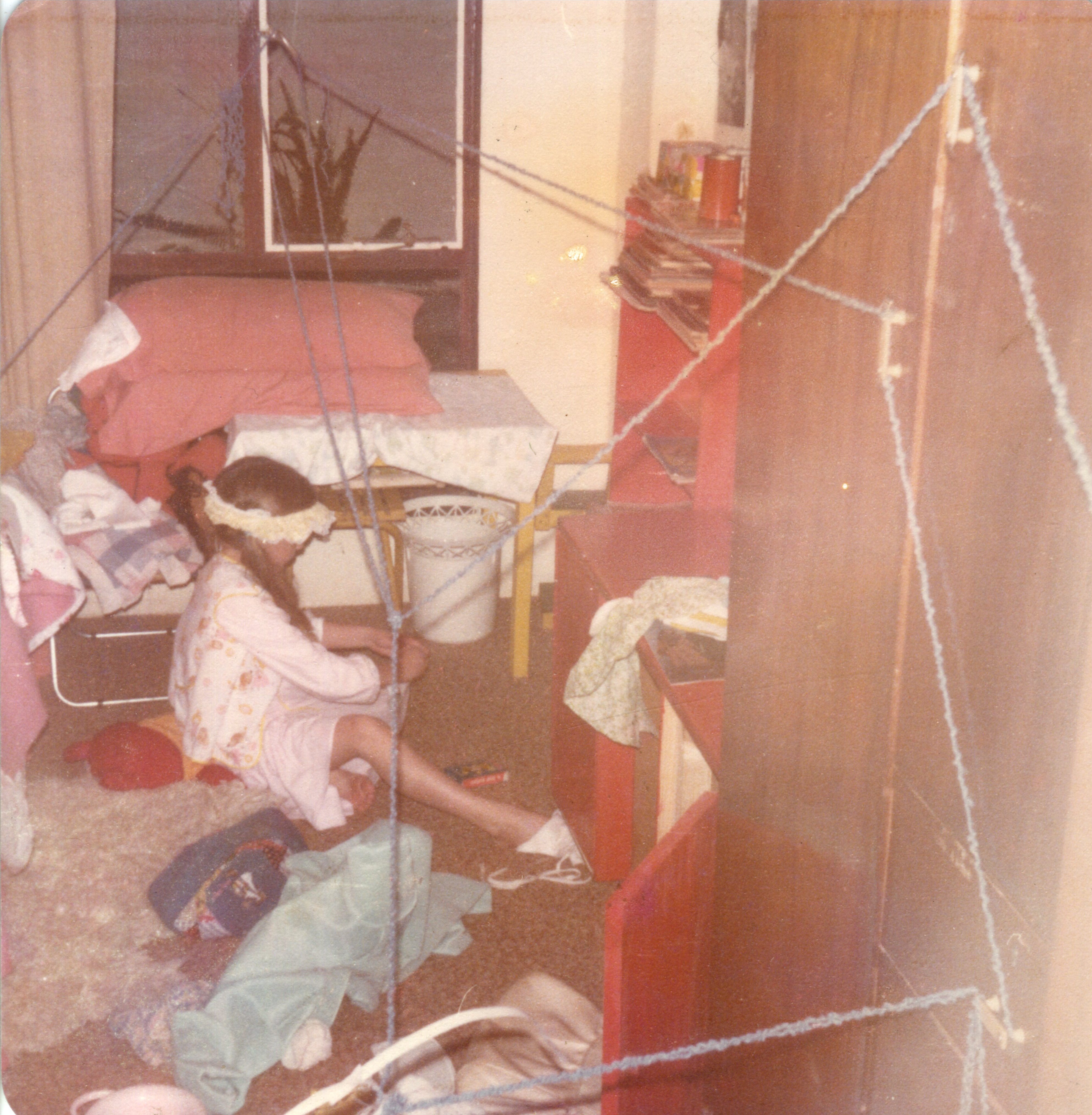
I had deconstructed a jersey to create the overhead installation and repurposed a tissue box cover as a headscarf.
The red teddy bear functions as a chair, and I see I’ve upcycled a gilet that probably belonged to a doll originally.
My checkered safety blanky (I still have it!) is not far out of reach, just behind me.
I wasn’t told to clean up my room or berated for destroying a sweater, instead I was applauded for my ingenuity.
Lessons From Growing up Wild!
This kind of upbringing, some might label it benign neglect, taught me to look after myself and figure things out very quickly.
We grew up poor, because not fitting in meant not being part of any social construct, even the financial one.
So if I wanted things for myself, I had to go out and find the money to pay for them.
I’ve held down jobs since I was 13 and had to learn early on to look out for myself , to trust my gut, my intuition, and navigate physical streets and social settings no one prepared me for.
I knew from the onset there was no one I could call for help, that no one was coming, that there was no safety net.
I suppose I learnt quickly what it means to take responsibility for your actions and decisions, and to do what you know to be right.
Following My North Star
I still follow my own North Star, and I’m still very unconventional, but it doesn’t matter in the least.
Every day, I wake up grateful for a new opportunity to be alive in this world and to be able to create new things.
What an incredible adventure we’re on!
✨ If this story resonated with you, I’d love to hear your thoughts. How did your childhood shape the way you see the world and create within it? Leave a comment below or share this with someone who needs a little reminder to trust their intuition.